(786) 685-4123

AI SEO & Generative Engine Optimization (GEO)


Help your business show up in AI answers on ChatGPT, Gemini, and Google AI Overviews.


What is Generative Engine Optimization (GEO)?

AI SEO & Generative Engine Optimization (GEO)

Search isn’t just “Google and a list of links” anymore. More people are asking tools like ChatGPT, Gemini, Perplexity, Claude, and Google’s AI Overviews to recommend services, compare options, and summarize the best next step.


That shift changes the game. If your business isn’t being picked up clearly and accurately by these systems, you can lose visibility—even if your traditional SEO is solid.


That’s where AI SEO, also known as Generative Engine Optimization (GEO), comes in. At Luminary Software LLC, we help businesses adapt to AI-driven discovery with content that’s easier to understand, easier to trust, and more likely to be included in AI-generated answers.


The Evolution of Search: From SEO to GEO

What is Generative Engine Optimization (GEO)?

Generative Engine Optimization (GEO) is the process of shaping your website and content so AI tools can understand what you do, who you serve, and why you’re credible—and then confidently use your content when generating answers.


In other words: it’s not only about ranking in search results. It’s about being the source AI systems pull from when people ask questions like “Who should I hire?” or “What’s the best option for my situation?”


GEO doesn’t replace SEO. It builds on it.


Why GEO Matters in the Age of AI-Powered Search

Why your business needs AI SEO now

AI-powered search is changing how customers make decisions. Instead of clicking through five websites, many users ask one question and accept one summary.


That creates both a challenge and an opportunity:


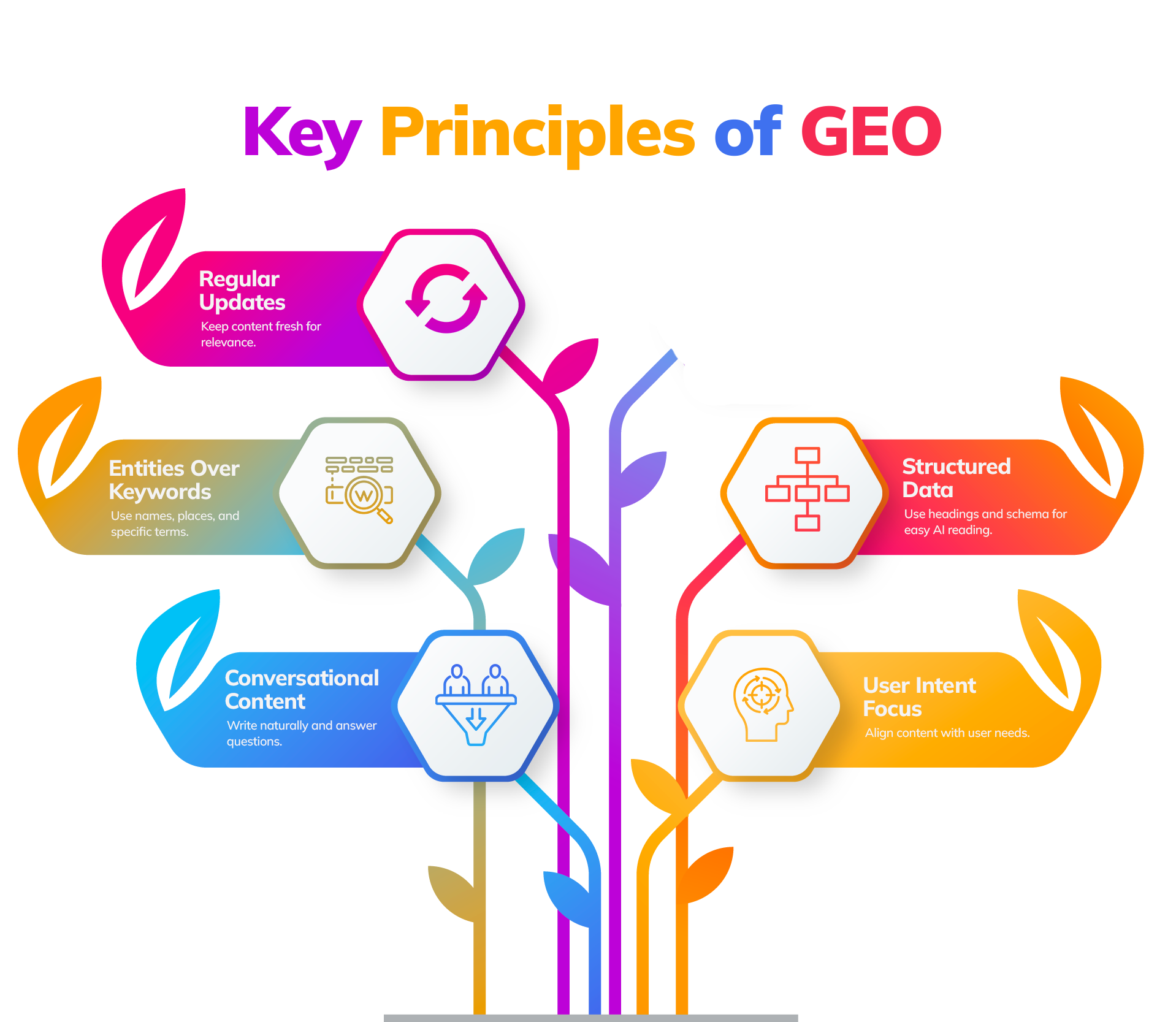
Key Principles of Generative Engine Optimization

What’s different about AI-driven search

AI engines tend to:


  • Focus on intent and meaning, not just keywords

  • Prefer content that’s clear, structured, and specific

  • Combine information from multiple sources into one answer

  • Avoid content that feels vague, overly promotional, or hard to verify


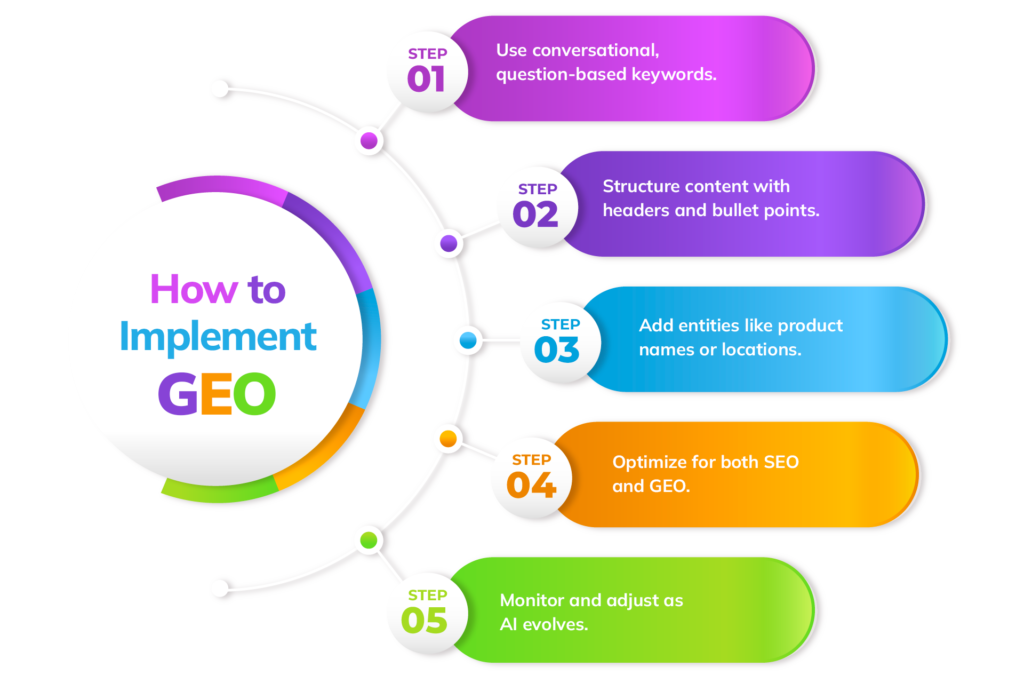
How to Optimize for Generative Engines

What GEO helps you accomplish

With the right GEO strategy, you can:


  • Increase the chances your business shows up in AI answers and summaries

  • Attracthigher-intent leads who are actively comparing solutions

  • Reduce the risk of AI describing your services inaccurately or incompletely

  • Build authority around the topics you want your brand associated with

  • Strengthen your long-term visibility as search continues to evolve


SEO vs. GEO: what’s the difference?

Traditional SEO is still essential—technical health, strong content, backlinks, performance, and mobile usability all matter. GEO simply reflects how discovery is changing.


Here’s the practical difference


Area Traditional SEO AI SEO / GEO
Goal Rank pages in search results Be included (and trusted) in AI-generated answers
Content focus Keywords + relevance Intent + clarity + entities + “answer-ready” structure
Best content types Blogs, landing pages, service pages FAQs, comparisons, definitions, how-tos, summaries
Key signals Links, technical SEO, relevance Structure, consistency, credibility, topical coverage
Typical user behavior Search → click → browse Ask → get an answer (often no click)


The goal with GEO is to make your content easy for AI to extract, summarize, and reuse—without losing accuracy.


How AI engines decide what to include (and why clarity wins)

AI systems don’t read your website the same way a human does. They look for information they can confidently interpret and compress into a helpful response.


Content tends to perform better in AI answers when it has:


  • Clear definitionsand direct responses (no long windups)

  • Clean structure: headings, short sections, bullet points, tables

  • Real specifics: examples, steps, timelines, “best for” guidance

  • Consistent language across pages (services named the same way everywhere)

  • Strong trust signals: proof, process, experience, transparency

  • Clear business identity (who you are, what you do, where you serve)


If your content is fuzzy or overly salesy, it’s harder for AI to rely on—and easier for it to skip.


The core ideas behind Generative Engine Optimization (GEO)

GEO is not magic. It’s mostly about making your site more helpful and more readable—both for humans and for machines.


1) Write for real questions people ask


Instead of guessing keywords, we focus on the questions that show buying intent:


  • “What’s the difference between SEO and AI SEO?”

  • “How do I show up in ChatGPT or AI Overviews?”

  • “Which option is better for my type of business?”

  • “What affects pricing and what’s included?”


2) Make content “answer-ready”


AI engines love content that gets to the point, then supports it. That means:


  • A short, clear explanation first

  • Details next

  • Helpful lists, steps, and FAQs when they fit


3) Make your brand unmistakable


A lot of AI confusion comes from inconsistent messaging across a website. We tighten up signals like:


  • What you do (in plain language)

  • Who you serve

  • What makes you different

  • Where you operate (if location matters)

  • Consistent service names and descriptions across key pages


4) Build topic authority (not random blog posts)


We organize content so it’s obvious what you’re an expert in:


  • A strong core page (pillar)

  • Supporting pages that go deeper

  • Internal links that connect the full story


5) Support it with solid technical foundations


GEO works best when your SEO fundamentals are clean:


  • Indexing and crawlability

  • Canonicals and duplicate content handling

  • Speed and mobile usability

  • Structured data (Schema) where appropriate


How Luminary Software LLC approaches AI SEO & GEO

We treat GEO like a practical system: strategy + content + structure + technical clarity. No hype. No “one weird trick.”


Typical GEO work includes


  • AI visibility and content clarity audit

    We review how your business is described, what’s missing, and what’s unclear.


  • Content improvements on money pages  (service pages, key landing pages)


    Stronger structure, clearer offers, better intent alignment, and FAQs that match real search behavior.


  • Topic clusters and internal linking

    A website that’s organized like a knowledge base—easy to navigate, easy to interpret.


  • Schema / structured data

    Implemented thoughtfully to improve clarity and context (not as a gimmick).


  • Trust-building upgrades

    Proof, process explanations, case-study style pages, and content standards that make your expertise obvious.


  • Measurement and iteration

    We monitor performance, refine what’s working, and strengthen topic coverage over time.


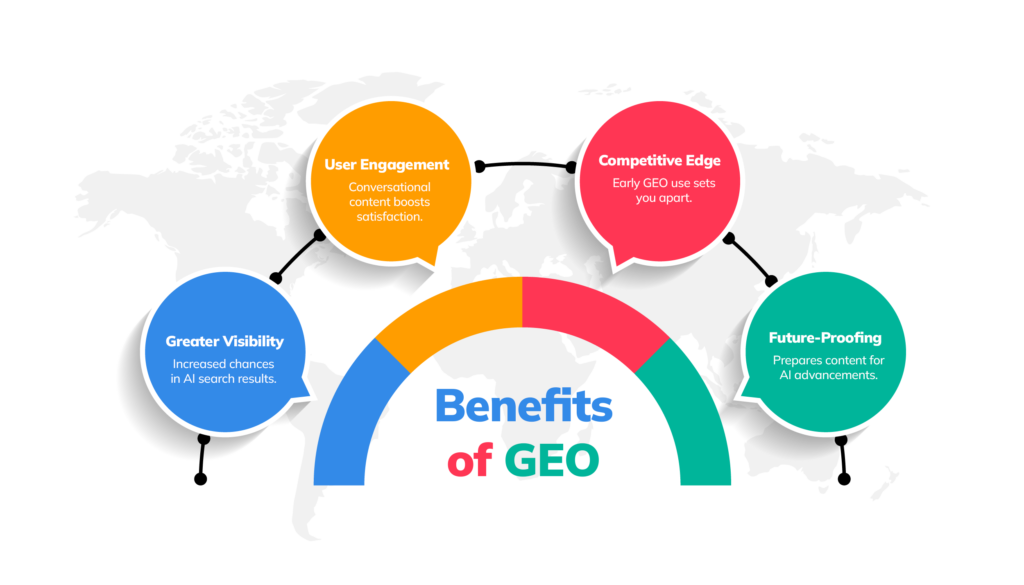
The Benefits of Generative Engine Optimization

What businesses get out of GEO

GEO isn’t about chasing a buzzword. It’s about staying visible as the way people search changes.


Benefits you can expect


  • More discovery from conversational and comparison-style searches

  • Stronger authority in your niche

  • Better user experience (clearer pages usually convert better)

  • Reduced reliance on a single channel for leads


GEO best practices (what to do consistently)

The businesses that win in AI search aren’t the ones publishing the most content—they’re the ones publishing the clearest content and keeping it current.


High-impact habits include:


  • Answer questions directly and thoroughly (without fluff)

  • Keep core pages updated as services evolve

  • Use consistent wording for key services across your site

  • Add FAQ sections where people naturally have questions

  • Strengthen internal linking as your site grows

  • Use visuals when they genuinely help (diagrams, short videos, charts)


AI SEO & Generative Engine Optimization

What’s the difference between GEO and traditional SEO?

Traditional SEO focuses on improving your visibility in search results. GEO focuses on making your content easy for AI engines to interpret and include in generated answers, especially for conversational, comparison, and “best option” queries.

Does GEO replace SEO?

No. GEO builds on SEO. Technical health and quality content still matter. GEO simply adds the clarity and structure AI systems depend on.

Can GEO improve my website overall?

Yes. A good GEO project usually improves content clarity, page structure, internal linking, and conversion flow—so it often helps traditional SEO and user experience at the same time.

What types of businesses benefit most from GEO?

GEO is especially useful for businesses where customers compare options before buying, including:

  • Software and IT services
  • Home and local services
  • Healthcare and wellness
  • Ecommerce brands with products that need explanation or comparison

How quickly will we see results from GEO?

It depends on your market, your existing authority, and how much content needs improvement. Many businesses see early positive movement after foundational updates, with stronger results building over time as authority and coverage expand.

How do you measure GEO success?

Depending on your setup and goals, we look at:

  • Organic growth in impressions and traffic
  • Engagement and conversion improvements on key pages
  • Performance gains for long-tail and question-based queries
  • Stronger brand clarity and consistency across the site